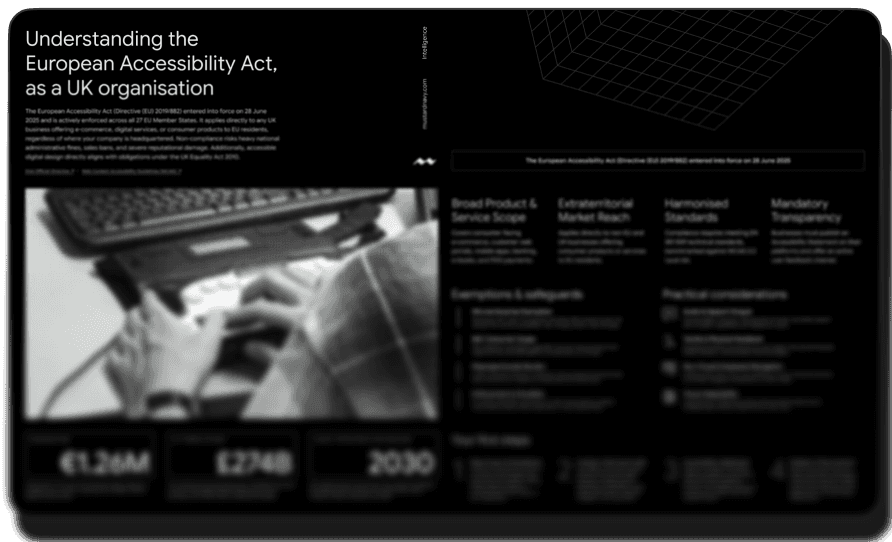
Everything your business needs to know about risk tiers, compliance obligations, and operational readiness.
What is the EAA?
The European Accessibility Act (Directive (EU) 2019/882) is actively enforced across all 27 EU Member States. Importantly, its extraterritorial, meaning it can apply directly to any UK organisation offering e-commerce platforms, mobile apps, or digital services to EU consumers.
Non-compliance carries severe commercial risks, including sales bans across EU markets and potentially large fines.
However, treating accessibility purely as a legal hurdle misses the bigger picture. Building inclusively inherently elevates the digital experience for all your customers delivering clearer interfaces, friction-free user journeys and naturally drive higher conversion rates. Commercially, this work seamlessly reinforces your existing obligations under the UK Equality Act 2010, and with inaccessible checkout flows currently costing UK businesses over £17B annually in abandoned baskets, prioritising digital inclusion turns a compliance requirement into a major revenue driver.
Why Read This Guide?
Navigating cross-border compliance, technical standards, and transition timelines can feel overwhelming for UK teams. We’ve condensed the key requirements into an executive summary designed specifically for UK leadership, product managers, and compliance officers.
Scope & Applicability: Clear criteria on how the Act impacts UK-based e-commerce stores, web portals, mobile apps, e-books, and ticketing terminals.
Harmonised Technical Standards: How to align your digital products with EN 301 549 standards, benchmarked against WCAG 2.1 / 2.2 Level AA.
The Commercial & UK Context: How EAA compliance intersects with the UK Equality Act 2010 and helps capture the £274B Purple Pound.
Mandatory Transparency: Guidelines for drafting compliant Accessibility Statements and establishing active user feedback channels.
Critical Timelines: Immediate rules for new digital launches vs. the June 2030 transition deadline for pre-existing contracts and legacy infrastructure.
Practical Remediation Steps: Practical guidance on non-visual navigation, visual adaptability, and tactile controls.