Dex Talent
Services
Product Design UX / UI Co-creation Optimisation
Description
Dex (meetdex.ai) is a UK-based agentic recruitment platform matching software engineers into the top available roles, competing directly with human recruiters. We ran an embedded growth engagement to optimise the product: hypothesis-led design updates shipped and measured against live product data over several months.
Services
Product Design UX / UI Co-creation Optimisation
Description
Dex (meetdex.ai) is a UK-based agentic recruitment platform matching software engineers into the top available roles, competing directly with human recruiters. We ran an embedded growth engagement to optimise the product: hypothesis-led design updates shipped and measured against live product data over several months.
Year
Timeline
5 weeks
Location
London, UK
+68%
signup-to-acceptance
+39%
Call engagement
x2
Role views per session
Introduction
Dex had already seen great success from the recently launched multi-modal AI agent, taking candidates from introduction to viewing and applying for relevant job roles.
Its agent spoke directly to candidates, asked real questions, and matched high-calibre software engineers to roles, going head-to-head with agencies used to charging tens of thousands per hire. The product was driven by a fasted pace development pipeline, and had been through several major iterations since launch. There was no shortage of ideas for what to fix next, and high platform engagement generated growing evidence for areas to refine. At the time, the Dex team had no internal designers, so they looked to Mustard Navy to provide product design expertise, and embed within the team to support with optimisations that would directly improve key metrics.

Challenge
Data showed candidates were somewhat distrustful of AI support, right up until the moment they engaged and saw the power of the agent in action.
Most candidates who matched with a role never went on to submit an application, and one misaligned match early on was often enough to break trust for good. In this early version of the product there was no profile, no account, and few ways to check back in once a call had happened, so a candidate who wanted to return to Dex had limited options of where to go. For candidates this meant they had to rely on their memory of past conversations, or start questioning the agent to recall what had already been discussed.
The Dex team had a growing list of hypotheses for what might fix this, alongside an ambitions roadmap of fresh features, new agentic capabilities and a passion for moving quickly in a very competitive startup space. What the team didn't have yet was a fast, reliable way to move from hypothesis to a launchable user experience that they had faith would move hte needle in the right direction.

Approach
We worked as part of the Dex team, sitting next to the data as it was analysed and the code as updates were built. Allowing use to work in incredibly fast iterations that generated evidence of design success.
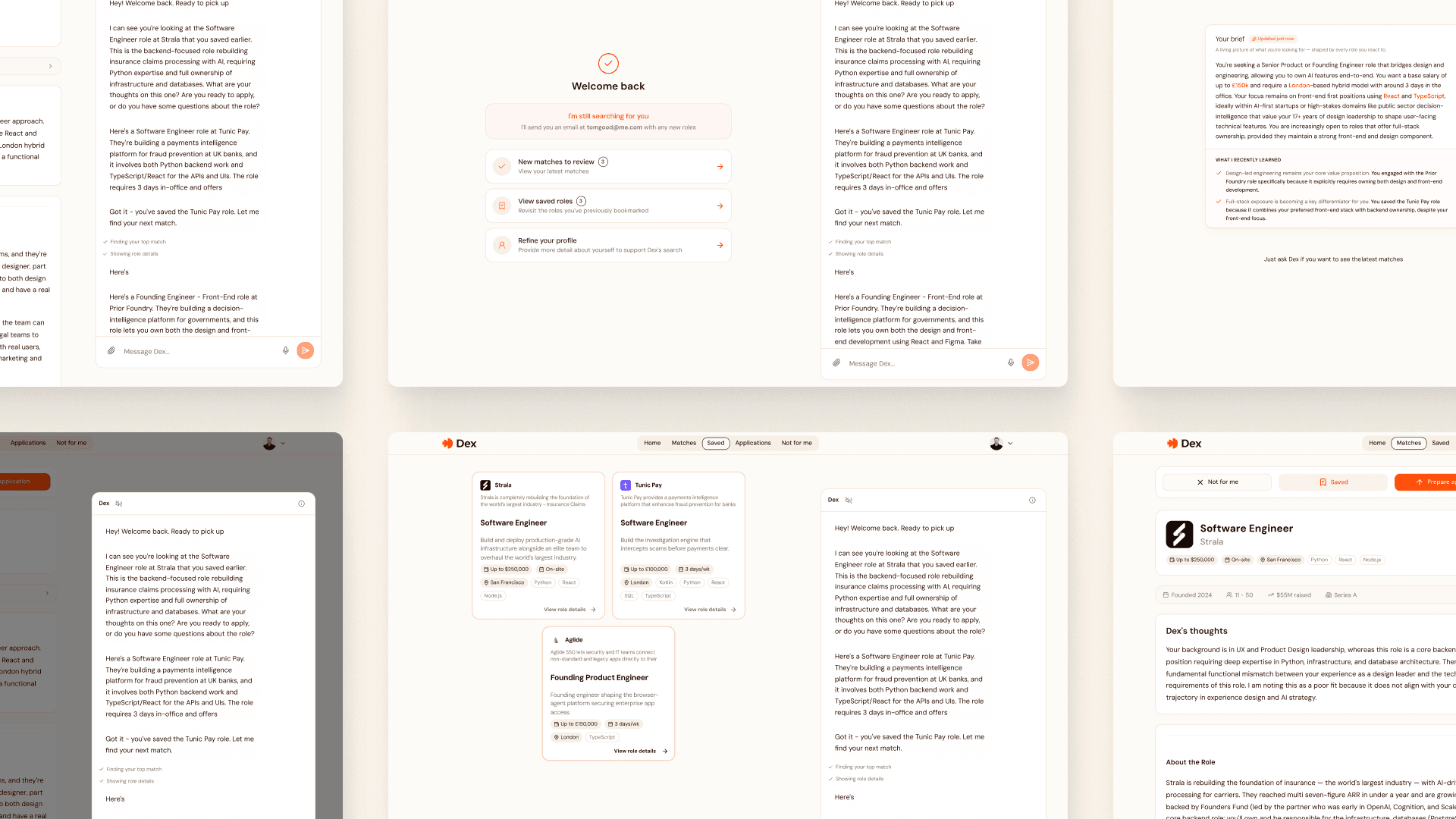
The person waiting on the other side of each decision was a software engineer who'd just spent twenty minutes talking to an AI agent about their career, then had nothing: no page to check, no sense of where they stood.
Dex had no in-house designer, so we worked embedded with their product and engineering team, watching the same signals they did: time in chat, time to first result, how often a candidate engaged with the roles they'd been shown.
Every idea went through the same test: form a hypothesis, define what success would look like, design it and ship it, then read the data before deciding what came next. The sharpest one: give a returning candidate their status back before showing them anything new. The fastest of these ran from idea to build to launch to first results in five days, with the live product doing the measuring and the next priority set by what the numbers showed.


Impact
The fastest experiment produced the biggest result.
Signup-to-acceptance rose from 8.5% to 14.3%, a 68% relative jump, and call engagement went from 49% to 88% once returning candidates could see where they stood before being asked to talk again, the change that came out of that five-day loop. Engaged candidates viewed more than double the roles per session, and voice call volume rose 400%. With results landing within days, priority didn't have to be argued for, it was decided by the numbers.
Alongside the metrics, Dex got something a data can't show: its first design system, wired into the codebase so the team's own vibe coding tools could turn a design straight into working front-end.

+68%
signup-to-acceptance
+39%
Call engagement
x2
Role views per session
Introduction
Dex had already seen great success from the recently launched multi-modal AI agent, taking candidates from introduction to viewing and applying for relevant job roles.
Its agent spoke directly to candidates, asked real questions, and matched high-calibre software engineers to roles, going head-to-head with agencies used to charging tens of thousands per hire. The product was driven by a fasted pace development pipeline, and had been through several major iterations since launch. There was no shortage of ideas for what to fix next, and high platform engagement generated growing evidence for areas to refine. At the time, the Dex team had no internal designers, so they looked to Mustard Navy to provide product design expertise, and embed within the team to support with optimisations that would directly improve key metrics.
Challenge
Data showed candidates were somewhat distrustful of AI support, right up until the moment they engaged and saw the power of the agent in action.
Most candidates who matched with a role never went on to submit an application, and one misaligned match early on was often enough to break trust for good. In this early version of the product there was no profile, no account, and few ways to check back in once a call had happened, so a candidate who wanted to return to Dex had limited options of where to go. For candidates this meant they had to rely on their memory of past conversations, or start questioning the agent to recall what had already been discussed.
The Dex team had a growing list of hypotheses for what might fix this, alongside an ambitions roadmap of fresh features, new agentic capabilities and a passion for moving quickly in a very competitive startup space. What the team didn't have yet was a fast, reliable way to move from hypothesis to a launchable user experience that they had faith would move hte needle in the right direction.
Approach
We worked as part of the Dex team, sitting next to the data as it was analysed and the code as updates were built. Allowing use to work in incredibly fast iterations that generated evidence of design success.
The person waiting on the other side of each decision was a software engineer who'd just spent twenty minutes talking to an AI agent about their career, then had nothing: no page to check, no sense of where they stood.
Dex had no in-house designer, so we worked embedded with their product and engineering team, watching the same signals they did: time in chat, time to first result, how often a candidate engaged with the roles they'd been shown.
Every idea went through the same test: form a hypothesis, define what success would look like, design it and ship it, then read the data before deciding what came next. The sharpest one: give a returning candidate their status back before showing them anything new. The fastest of these ran from idea to build to launch to first results in five days, with the live product doing the measuring and the next priority set by what the numbers showed.
Impact
The fastest experiment produced the biggest result.
Signup-to-acceptance rose from 8.5% to 14.3%, a 68% relative jump, and call engagement went from 49% to 88% once returning candidates could see where they stood before being asked to talk again, the change that came out of that five-day loop. Engaged candidates viewed more than double the roles per session, and voice call volume rose 400%. With results landing within days, priority didn't have to be argued for, it was decided by the numbers.
Alongside the metrics, Dex got something a data can't show: its first design system, wired into the codebase so the team's own vibe coding tools could turn a design straight into working front-end.
+68%
signup-to-acceptance
+39%
Call engagement
x2
Role views per session
Introduction
Dex had already seen great success from the recently launched multi-modal AI agent, taking candidates from introduction to viewing and applying for relevant job roles.
Its agent spoke directly to candidates, asked real questions, and matched high-calibre software engineers to roles, going head-to-head with agencies used to charging tens of thousands per hire. The product was driven by a fasted pace development pipeline, and had been through several major iterations since launch. There was no shortage of ideas for what to fix next, and high platform engagement generated growing evidence for areas to refine. At the time, the Dex team had no internal designers, so they looked to Mustard Navy to provide product design expertise, and embed within the team to support with optimisations that would directly improve key metrics.
Challenge
Data showed candidates were somewhat distrustful of AI support, right up until the moment they engaged and saw the power of the agent in action.
Most candidates who matched with a role never went on to submit an application, and one misaligned match early on was often enough to break trust for good. In this early version of the product there was no profile, no account, and few ways to check back in once a call had happened, so a candidate who wanted to return to Dex had limited options of where to go. For candidates this meant they had to rely on their memory of past conversations, or start questioning the agent to recall what had already been discussed.
The Dex team had a growing list of hypotheses for what might fix this, alongside an ambitions roadmap of fresh features, new agentic capabilities and a passion for moving quickly in a very competitive startup space. What the team didn't have yet was a fast, reliable way to move from hypothesis to a launchable user experience that they had faith would move hte needle in the right direction.
Approach
We worked as part of the Dex team, sitting next to the data as it was analysed and the code as updates were built. Allowing use to work in incredibly fast iterations that generated evidence of design success.
The person waiting on the other side of each decision was a software engineer who'd just spent twenty minutes talking to an AI agent about their career, then had nothing: no page to check, no sense of where they stood.
Dex had no in-house designer, so we worked embedded with their product and engineering team, watching the same signals they did: time in chat, time to first result, how often a candidate engaged with the roles they'd been shown.
Every idea went through the same test: form a hypothesis, define what success would look like, design it and ship it, then read the data before deciding what came next. The sharpest one: give a returning candidate their status back before showing them anything new. The fastest of these ran from idea to build to launch to first results in five days, with the live product doing the measuring and the next priority set by what the numbers showed.
Impact
The fastest experiment produced the biggest result.
Signup-to-acceptance rose from 8.5% to 14.3%, a 68% relative jump, and call engagement went from 49% to 88% once returning candidates could see where they stood before being asked to talk again, the change that came out of that five-day loop. Engaged candidates viewed more than double the roles per session, and voice call volume rose 400%. With results landing within days, priority didn't have to be argued for, it was decided by the numbers.
Alongside the metrics, Dex got something a data can't show: its first design system, wired into the codebase so the team's own vibe coding tools could turn a design straight into working front-end.